
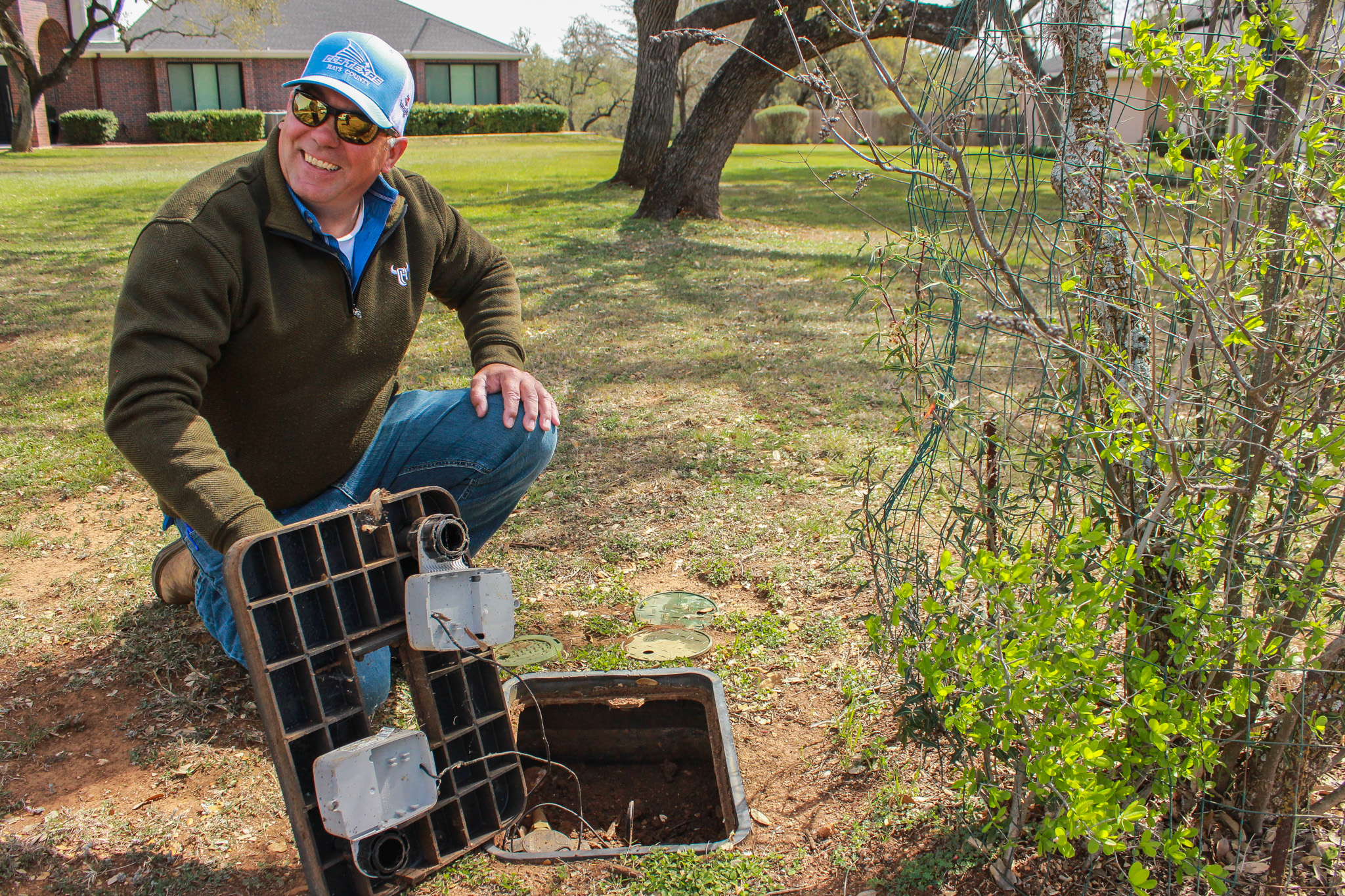
Tim Young, General Manager of Operations at PGMS, beside a smart meter in the Ruby Ranch neighborhood.
It might be surprising to hear Ruby Ranch Water Supply Corporation (Ruby Ranch WSC) had overpumping penalties with the District just over a year ago. Now, we’re featuring them as a shining example of water conservation in our Well Owner Spotlight series. What’s the secret behind their remarkable turnaround and impressive water savings?
The Ruby Ranch Community
Ruby Ranch is a neighborhood in Buda with just under 250 homes, each with about three acres. Beautiful live oaks dot the yards of large, ranch-style homes amongst rolling green hills. Houses were first built there in 1999, and now only a few empty plots remain. Early on, the neighborhood established the Ruby Ranch Water Supply Corporation (Ruby Ranch WSC) to provide water for the community, whose sole source has always been the Barton Springs-Edwards Aquifer Conservation District (District). They also use Professional General Management Services (PGMS) to manage water utilities.
Over the years, the neighborhood grew, and Ruby Ranch WSC stayed within their water allotment from the District. They were innovative and forward-thinking as they considered water for the community in the future. In 2019, Ruby Ranch was the District’s first permit holder to implement aquifer storage and recovery (ASR), allowing the community to store water underground in a portion of the aquifer during wetter periods for later use.
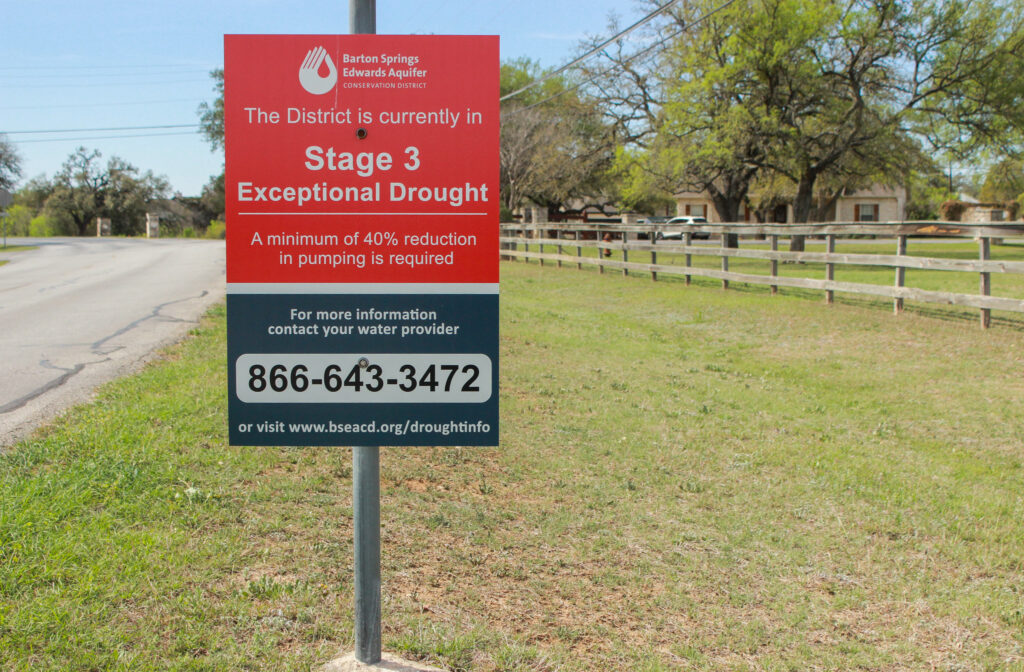
Ruby Ranch WSC drought signage with the neighborhood in the background.
Difficulties with Drought
Despite innovative ASR and years of staying within their permitted limits, the severe drought conditions of 2023 brought new challenges. Ruby Ranch WSC exceeded its permitted groundwater use for several months at the end of that year.
At the same time, the District declared Stage IV Exceptional Drought (now known as Stage 3 Exceptional Drought) for the first time in its history in December 2023. As a result, Ruby Ranch WSC’s permit was reclassified, lowering the amount of groundwater the system was allowed to pump.
The Ruby Ranch WSC board worked with the District to implement conservation strategies. They launched a newsletter to educate residents about drought conditions, installed drought awareness signage throughout the neighborhood, offered rebates for low-flow fixtures, and adjusted their rate structures. Yet, these efforts didn’t reduce water use enough to bring the system back within its permitted limits. “We were trying everything we could think of, but nothing seemed to move the needle enough,” said Thomas Doebner, long-time board member of Ruby Ranch WSC and resident of the neighborhood.
Faced with continued drought conditions, overpumping, and rising penalties in early 2024, Ruby Ranch WSC began exploring new options. Some possibilities, like importing water from neighboring systems, would have cost millions of dollars and simply weren’t feasible solutions.
Solutions Through Smart Meters
Ruby Ranch WSC then threw the equivalent to a “Hail Mary” when they pursued advanced metering infrastructure (AMI) or “smart meters”. For a small system serving fewer than 250 homes, the estimated cost of the upgrade (around $200,000) was still significant. They communicated with systems like the cities of Buda and Austin to get input on their experiences transitioning to smart meters. Working with the District, Ruby Ranch WSC was able to apply some of their penalty funds toward the smart metering instead, helping offset some of the cost of implementing the new system.
Once installed, the smart meters immediately began providing valuable insight into how water was being used throughout the Ruby Ranch community.
Operators were able to see detailed usage patterns and quickly identify customers with unusually high water use or potential leaks. Before the system was even launched publicly, PGMS staff reviewed the data and began calling customers in May 2025 whose usage suggested problems. “We could tell them, ‘You’re using water at 2am—here’s how much,’” explained Tim Young, General Manager of Operations at PGMS.
“Most people were very appreciative. A big one is residents didn’t realize how much water irrigation uses,” Tim noted. “They’d think it was a few hundred gallons a month, but it’s thousands.”
The smart meter system also sends automatic alerts by email or text to homeowners when potential leaks or abnormal water use are detected. Customers who create online accounts can customize alerts and track their daily water use. These tools give residents the information they need to quickly address leaks and adjust their water use instead of finding out when they get an expensive bill the following month.
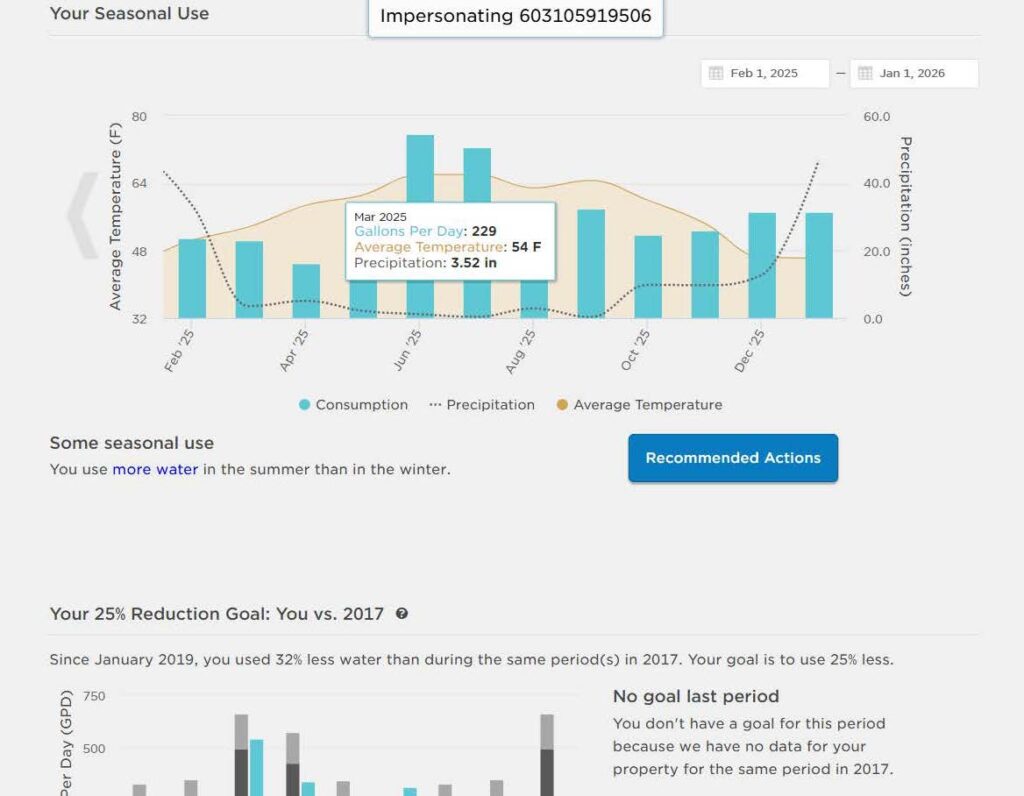
A look at a Ruby Ranch WSC customer’s online portal for their smart meter system.
Conservation Pricing and Infrastructure Savings
Alongside the installation of smart meters, Ruby Ranch WSC also implemented a progressive water rate structure, which charges higher per-unit prices as consumption increases.
Under the new payment structure, costs for basic household water use (5,000 gallons or less) remain low, and rates increase significantly for the highest levels of consumption (30,000 gallons or more). The goal is to discourage excessive water use, particularly large-scale irrigation, while ensuring customers who use modest amounts of water are not subsidizing heavy users.
The rate structure also adjusts accordingly with the District’s drought stage. While rates are currently adjusted for Stage 3 Exceptional Drought, they will increase for all users if the District moves to Stage 4 Emergency Response Period. This encourages community members to further conserve water when resources are limited and helps Ruby Ranch WSC cover overpumpage fees that may occur.
Infrastructure-wise, Ruby Ranch WSC previously had mechanical meters, which had to be replaced every five to six years. With the new ultrasonic smart meters, that lifespan is expected to increase to 10-15 years. Combined with more accurate data, reduced water loss, and fewer penalties from the District, Thomas believes, “In 10 years we will have more than recouped what we spent.” For a small water system, these improvements represent meaningful savings in both water and operating costs.
A Win for Water
The combination of improved communication, conservation pricing, and smart meter technology has made a measurable difference. In the last six months Ruby Ranch WSC’s water usage has been reduced by 42.5% compared to the same timeframe in 2025. This means millions of gallons of groundwater have already been saved.
Ruby Ranch WSC has not had an instance of non-compliance for 11 months. Even if the District moves into Stage 4 Emergency Response this year, Thomas and Tim are confident their system will remain within their allotment. “I would recommend AMI meters to any water system,” Thomas said. “I don’t care what size they are. That’s the way to go.”
The District is proud of the accomplishments of the Ruby Ranch WSC and the dramatic groundwater conservation that’s resulted. If anyone reading this article is thinking about using smart meters for their system, the District would be glad to continue the conversation with you and connect you with success stories like Ruby Ranch WSC.