
Choosing Rainwater Harvesting
For most Texans, a private water well is a badge of independence. For Hank Miller, his well became the reason he stopped using groundwater almost entirely.
Hank and his wife, Eva Reed, have lived in the River Mountain Ranch neighborhood since 2014 after moving from Mason County. Their home sits within the District’s boundaries and has a 600 to 700 feet deep well that sits within the Cow Creek formation of the Trinity Aquifer. According to Hank, one shower with the hard water from the well was all it took to make up his mind.
“We already knew what rainwater was like,” Hank said. “Clean taste, good showers, good water. After using that well water, I decided we were going to be 100% rainwater.”
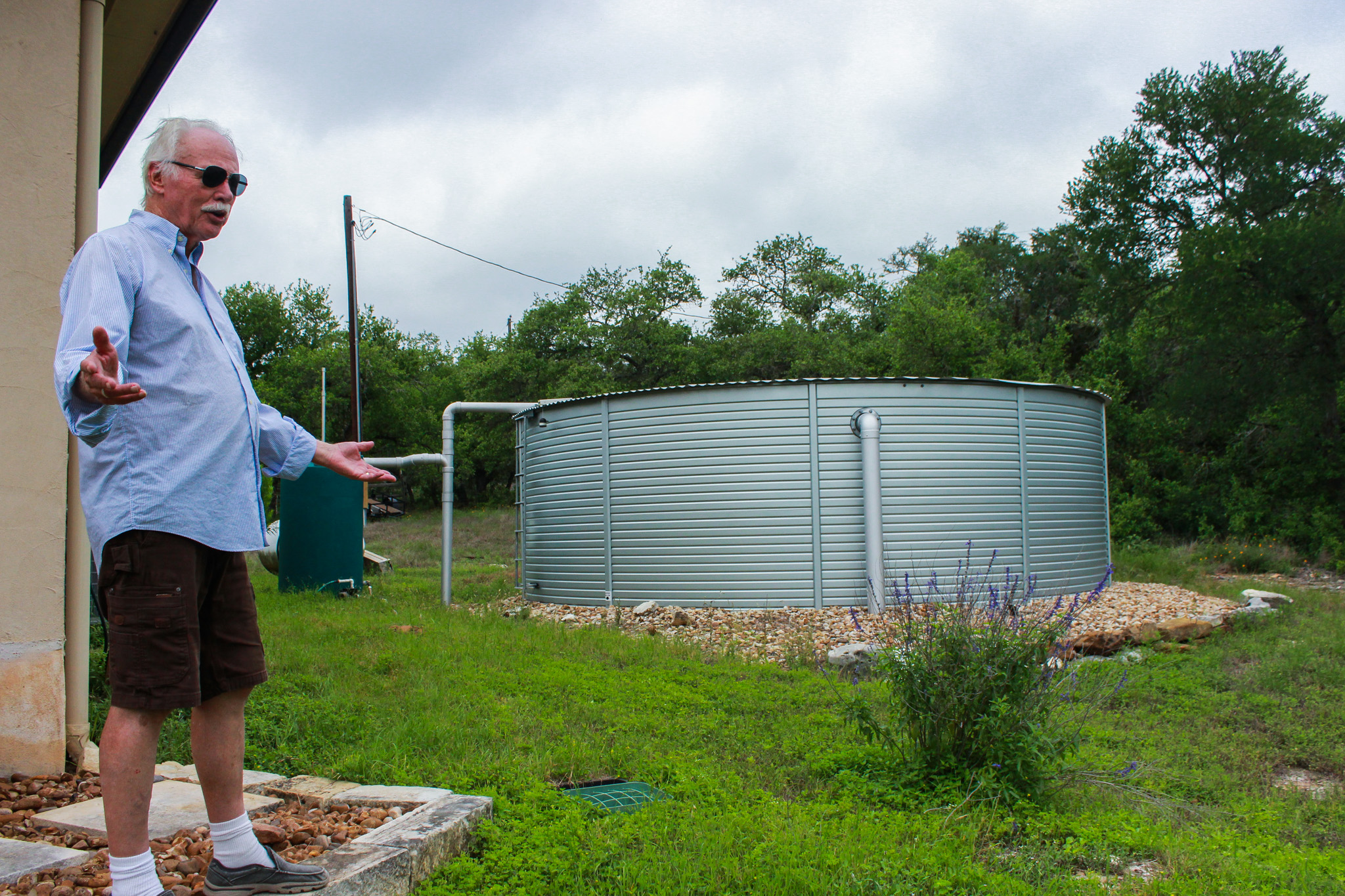
Today, Hank and Eva’s home runs entirely on a rainwater harvesting system fed by nearly 4,000 square feet of roof area. Their well remains in place primarily as a backup and serves as a long-term monitoring well for the District.

Hank and Eva were not new to rainwater harvesting when they arrived in Hays County. Years earlier, while building a home in Mason County, they discovered that drilling a water well through solid granite would cost an estimated $65,000. Instead, Hank installed a rainwater harvesting system for about $15,000.
“That was back in 2007,” he said. “Even then, it just made more sense.”
After seven years of successfully living on harvested rainwater in Mason County, the Millers brought that experience with them when they moved to River Mountain Ranch.
Their Home System
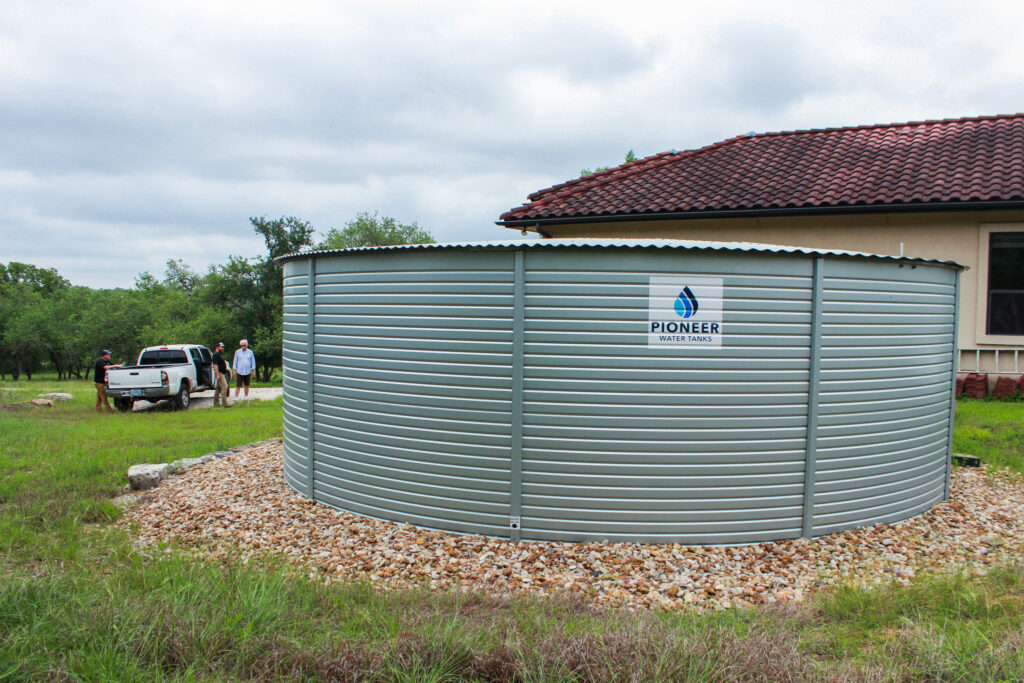
Hank’s current setup originally included a 10,000-gallon fiberglass storage tank. But after several dry years and concerns about increasingly unpredictable rainfall, Hank upgraded to a 20,000-gallon tank about five years ago.
“I woke up one day and realized 10,000 gallons wasn’t enough,” he said. “That only lasts about three months for us.” The system has proven remarkably resilient. Hank estimates the home can now operate on as little as 12 inches of annual rainfall.
The couple uses roughly 3,000 gallons of water per month for all household needs. While Hank said they use water normally and don’t consider themselves especially conservative water users, they have incorporated a hot water recirculation system. This delivers hot water almost instantly at faucets and showers, eliminating the need to let gallons of water run down the drain while waiting for it to warm up.
Hank’s system relies on simple but intentional management practices. During long dry periods, he manually diverts the first flush of rainfall away from the storage tanks, allowing dust and debris collected on the roof to wash off before collection begins.
“The first tenth of an inch is the dirty water,” he explained. “After that, I’ll shut the drains and start collecting.”
Hank and Eva also maximize reuse of household water through their aerobic septic system. Treated wastewater irrigates several pecan and maple trees on the property, which Hank says likely would not have survived the recent dry years otherwise.
Alternative Uses for the Well
Although Hank still maintains his Trinity well, he rarely uses it.
According to Hank, the water quality challenges were immediate and severe. He described the well water as extremely hard, to the point that some of their trees died when irrigated with it. The well remains operational and can still supply the house if needed. Hank has a connection system that allows him to route well water through a pre-filter and into the home during emergencies.
Additionally, since 2014, the District has used the well as part of its groundwater monitoring network, collecting water-level data to better understand conditions in the Trinity Aquifer. Hank said participating in the monitoring program was an easy decision.
“It seemed like a sensible idea for collecting data,” he said. “People need to understand we’re running out of water.”
Over the years, Hank has watched changing groundwater and surface water conditions across Central Texas with growing concern. He remembers when creeks flowed more consistently, Jacob’s Well ran continuously, and Lake Travis regularly stayed full.
“People think because it still rains sometimes that we’re fine,” he said. “But the lakes are going down, springs are slowing, and development keeps growing.”
He believes rainwater harvesting deserves more attention as both a tool and a long-term water supply strategy.
“If you have a well, you’re going to spend money on drilling, maintenance, and water treatment,” Hank said. “You can put in rainwater harvesting and have really good water.”
Looking Ahead
Hank knows rainwater harvesting is not always the easiest choice. Initial installation costs can be intimidating, and many homeowners remain unfamiliar with the technology. After nearly two decades of living on harvested rainwater, he still says it’s a practical and obvious solution for areas where groundwater availability grows increasingly uncertain.
“People think rainwater is just water running down the ditch,” he said. “I tell them, ‘No. I’m drinking water straight out of the sky.’”