
One household’s journey of transitioning to 100% rainwater harvesting.
__________
Want to learn more about rainwater harvesting? Join us for ‘Introduction to Rainwater Harvesting Event’ on Tuesday, April 28 1:00-2:30pm at Dripping Springs Presbyterian. You’ll hear from experts about the basics and benefits of having a system of your own.
Learn more and register for free at www.bseacd.org/rainwaterharvestingevent.
This is a collaborative event brought to you by Barton Springs-Edwards Aquifer Conservation District, Hays Trinity Groundwater Conservation District, Southwestern Travis County Groundwater Conservation District, Hill Country Alliance, and Rainbees.
__________
Central Texas is no stranger to drought. In the 1930’s, Texas meteorologist Isaac Klein reportedly said, “Texas is a land of eternal drought, interrupted occasionally by biblical floods.” But with climate change, these periods of drought are lasting longer. We’re also seeing intensifying rainstorms and catastrophic flooding, as was experienced in the Texas Hill Country last July.
The Barton Springs-Edwards Aquifer Conservation District (District) is seeing declines in groundwater in both the Edwards and Trinity aquifers based on our network of over 50 monitoring wells. Edwards Aquifer wells are approaching record lows while many Trinity wells have already surpassed theirs. The District is approaching Stage 4 Emergency Response Period, which would be the most severe drought declaration in the organization’s 39-year history.
While the area continues to grow, more wells, or ‘straws’ are going into the ground with less water being available. This news can be disheartening, but thankfully there is a viable alternative that some community members have already embraced.
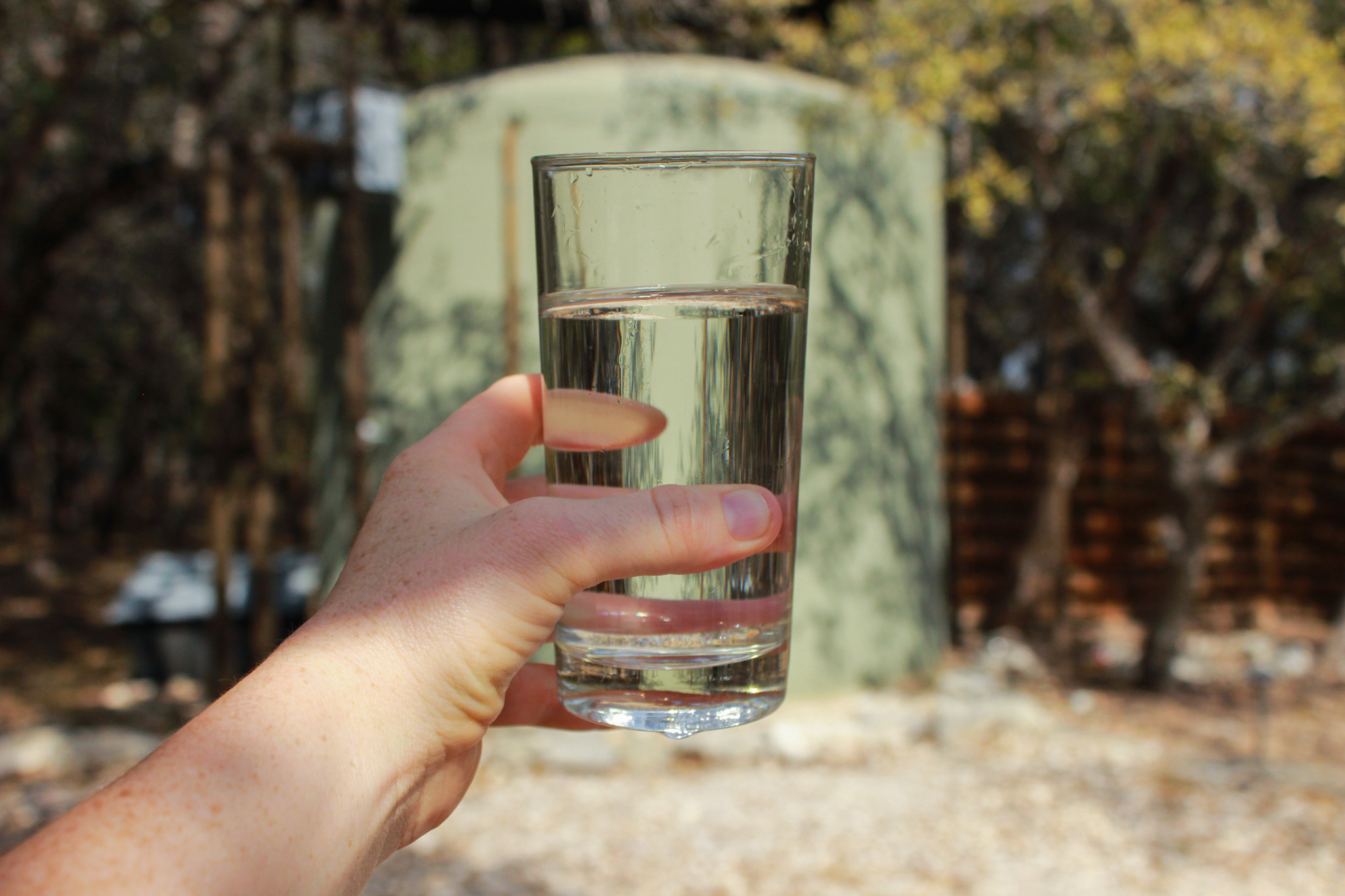
Rick Scadden is the Board President for the Southwestern Travis County Groundwater Conservation District (SWTCGCD). He and his wife have lived soley on rainwater for the last 30 years. As I arrived to interview him about his rainwater harvesting system, he greeted me with a glass of water and said enthusiastically, “Try some for yourself.”
Rick lives in The Homestead neighborhood near the Hill Country Galleria. As I drove to his house, I was not looking forward to the traffic and busyness of the Bee Cave area. Yet, when I turned off on his road, I was quickly greeted with beautiful, rolling hills covered in live oaks and ashe junipers. This landscape graciously muted the sounds of the highway and transported me to the tranquility of the Hill Country we all know and love.
Rick and his wife are self-proclaimed evangelicals for rainwater harvesting. Their home was built in 1978 by a previous owner and came with a well in the Middle Trinity Aquifer. They purchased the home in 1986 and weren’t fans of the hard water and how it impacted the plumbing fixtures in their home, including spots on dishes and faucets clogging with minerals. Rick, an engineer by training and inclination, also saw the writing on the wall about limited groundwater resources. In 1995, they installed an 8,500 gallon tank for rainwater harvesting and haven’t looked back.

Rick’s house in The Homestead community in Bee Cave.
This original tank catches rainfall from approximately 1,200 square feet on their two-story home. Rain falls on the roof, gutters channel it into PVC piping, and gravity carries it to the tank. Because Rick’s home sits at a higher elevation than the tank inlet, the system relies on hydraulic head rather than mechanical conveyance. Before the water reaches the tank, it passes through a debris filter to remove leaves and larger particles.
A pressure pump sends the water to the next portion of our tour: underneath the house. There, the water passes through a pressure tank (which regulates flow), then two stages of filtration. Finally, it moves through an ultraviolet (UV) disinfection unit. The UV light doesn’t “kill” bacteria in the traditional sense. Instead it renders them unable to reproduce, effectively neutralizing any health risk.
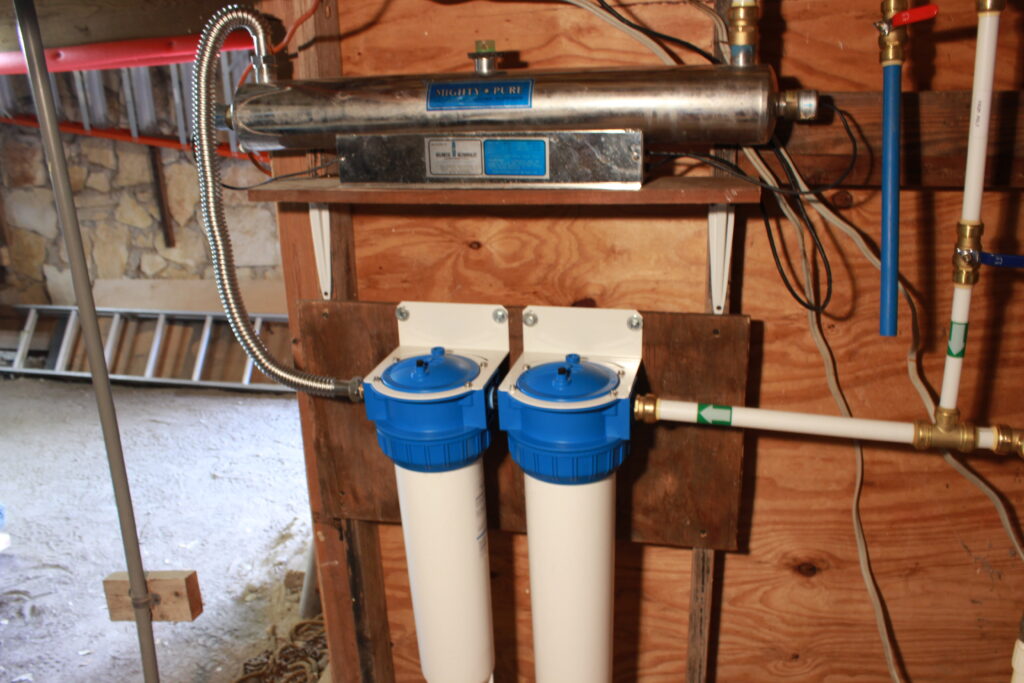
Filtration and sanitation components of Rick’s rainwater harvesting system, which are located under his house.
Rick’s rainwater harvesting system has required maintenance over the years. He’s replaced components like the pressure tank and pump. Filters are replaced roughly every six months and the UV bulb periodically as needed. The original fiberglass cistern, however, remains in excellent condition after three decades. He painted it for UV protection and built a cover to shield it. Freeze protection—via insulation, heat tracing, and thermal-coupled heaters—has also been added to ensure reliability during extreme cold snaps like what we saw in 2021 with Winter Storm Uri.
The payoff? Remarkably high-quality water. Rainwater is naturally ‘soft’, meaning it has a little to no total dissolved solids in it. The water tastes fresh, showers feel better, and dishes dry without spots. Compared to the mineral-heavy well water they once used, the difference is noticeable.
Rainwater harvesting does not solve all Central Texas’ water challenges since it is still dependent on rainfall patterns. Rick noted a handful of times over the years when he had to have water trucked in to fill his tank. This includes 2011 when it rained less than 20 inches in the Austin area. (The average is closer to 34 inches).
Last year, thinking ahead about climate variability and the reality of a 30-year-old system, Rick added another 5,000-gallon tank behind his garage. This new tank collects runoff from the garage roof and operates independently with its own submerged pump. The two systems run separately, providing redundancy and added capacity. In total, they now have 13,500 gallons of storage.
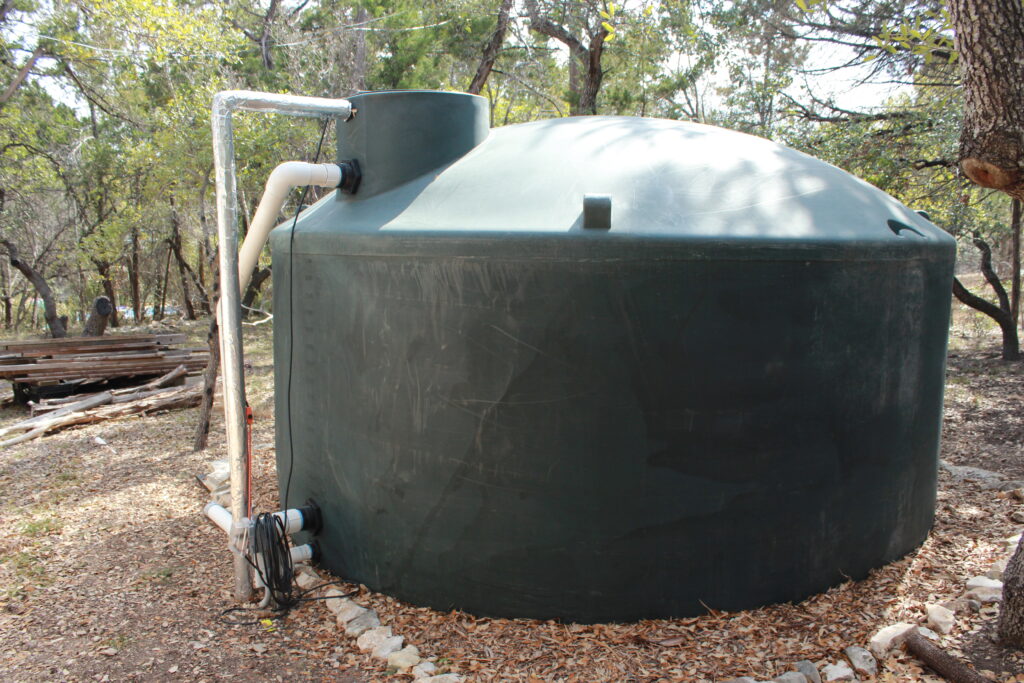
Rick’s newest rainwater cistern holds 5,000 gallons and was added in 2025.
“It’s not about a magic number,” Rick explained. “One size does not fit all.” Tank size depends on roof area, household demand, available space, slope, budget, and long-term goals. For him, the additional tank offers peace of mind in an era of increasing climate uncertainty.
As our aquifers decline and Stage 4 Emergency Response Stage looms, rainwater harvesting is not merely a novelty. For some households, it is a practical, sustainable path forward that reduces pressure on shared groundwater resources while increasing individual water security.
It was both inspiring and encouraging to see Rick’s setup firsthand. There’s something refreshing about seeing people embrace sustainable strategies that may fall outside the norm, yet clearly demonstrate how practical and attainable they really are. Between the native landscaping, solar panels, and rainwater harvesting system, Rick and his wife show that it’s possible to reduce your home’s environmental impact while increasing self-reliance and maintaining a beautiful house and surrounding landscape.